
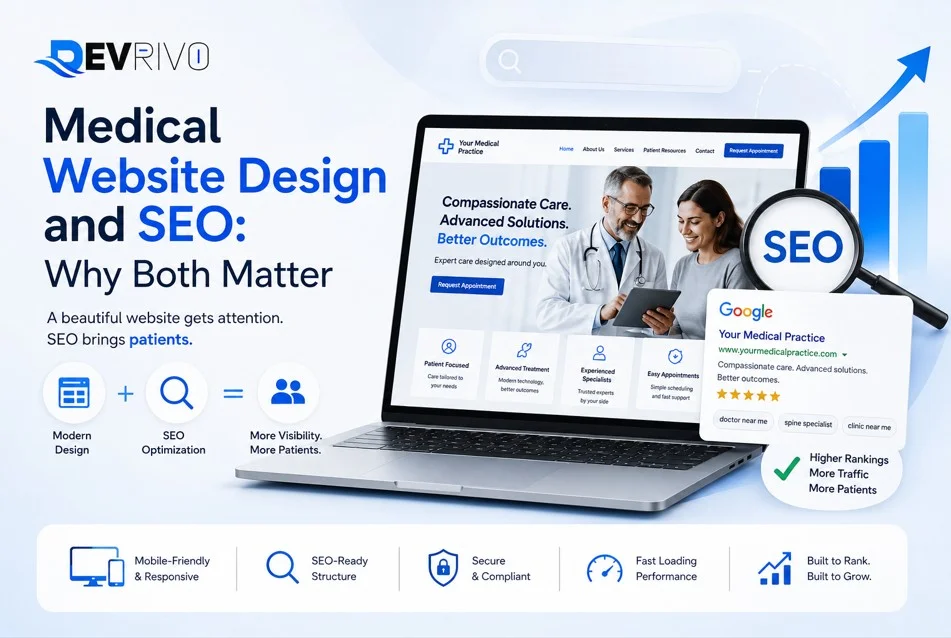
A medical website can look professional and still struggle to attract organic traffic.
It can also rank for relevant searches but make it difficult for patients to understand services, find providers, or schedule an appointment.
That is why medical website design and SEO need to work together.
Design determines how patients navigate and interact with the website. SEO helps search engines discover, understand, and surface the site’s pages for relevant searches. When these systems are planned together, the website can provide a better experience for both patients and search engines.
For doctors, clinics, dentists, and other healthcare organizations, an SEO-friendly medical website should combine:
Clear architecture + patient-focused UX + technical SEO + useful content + strong performance + accessible design + conversion paths.
Why Medical Website Design and SEO Are Connected
Medical website design and SEO are often treated as separate projects.
A designer focuses on layouts, colors, typography, images, and user experience. An SEO specialist focuses on keywords, content, technical issues, internal links, and search visibility.
In reality, many of these areas overlap.
For example, the way a website organizes its pages affects:
- How patients find information
- How search engines discover important pages
- How internal links distribute relevance
- How clearly services are categorized
- How easily users move toward an appointment
- How search engines understand relationships between topics
Consider a healthcare practice offering several orthopedic services.
A weak structure might place every treatment on one generic services page.
A stronger structure could organize the site around:
Orthopedic Services → Individual Treatments → Conditions → Providers → Locations → Appointment
This gives patients clearer paths through the website while creating meaningful relationships between related pages.
Design should support search intent
SEO is not simply adding keywords to attractive pages.
If a patient searches for “knee replacement surgeon,” the website should make it easy to discover information about:
- Knee replacement
- The relevant surgeon
- The surgeon’s specialty
- The locations where the service is offered
- What patients should know
- How to contact or schedule with the practice
The design and architecture should support that journey.
How Website Architecture Affects SEO
Website architecture describes how pages are organized and connected.
A search-friendly healthcare website should make important pages easy to discover and understand.
A simplified structure might look like:
Homepage
→ Specialty
→ Services
→ Individual Treatment Pages
→ Providers
→ Locations
→ Appointment
Not every medical practice needs exactly this structure. The architecture should reflect the organization’s actual services, specialties, providers, and locations.
Create logical topic relationships
Suppose a neurology practice offers:
- Migraine treatment
- Epilepsy care
- Parkinson’s disease care
- Neuropathy treatment
Each important service can have its own page when there is enough useful information and distinct patient/search intent.
Those pages can then connect to:
Neurologist → Neurology Services → Condition → Treatment → Location → Appointment
This creates a logical topical structure rather than a collection of disconnected URLs.
Avoid unnecessary page creation
More pages do not automatically mean better SEO.
Creating dozens of thin pages with little unique value can make a website harder to maintain and may provide a poor user experience.
A page should exist because it serves a meaningful purpose for patients, the practice, or a distinct search intent.
Why Page Speed Matters for Medical Websites
Patients should not have to wait for a healthcare website to become usable.
Large images, excessive scripts, inefficient plugins, poor hosting, and unnecessary animations can all contribute to slower pages.
Performance affects the user experience, particularly on mobile devices and slower connections.
Google’s Core Web Vitals focus on three aspects of page experience:
- Largest Contentful Paint (LCP) – loading performance
- Interaction to Next Paint (INP) – responsiveness
- Cumulative Layout Shift (CLS) – visual stability
For a medical website, performance improvements may include:
- Compressing large images
- Serving appropriately sized images
- Reducing unnecessary JavaScript
- Removing unused plugins
- Improving caching
- Optimizing fonts
- Reducing layout shifts
- Improving server response time
- Testing mobile performance
However, performance should not be treated as a shortcut to higher rankings.
A technically fast website still needs useful content, relevant pages, good architecture, and a strong overall search experience.
The goal is to make the website fast enough for patients and technically healthy enough for search engines.
Mobile UX and Medical Search
Healthcare searches frequently happen when people are away from a desktop computer.
A patient may search for a doctor, clinic, urgent care service, phone number, office address, or appointment information from a smartphone.
That makes mobile usability an essential part of medical website design.
A mobile-friendly medical website should make it easy to:
- Read text without excessive zooming
- Open the navigation menu
- Tap phone numbers
- Find appointment buttons
- Complete forms
- Find office locations
- Read service information
- Access important contact details
Test the most important patient journeys
Do not only test whether the homepage looks good on a phone.
Test actual tasks.
For example:
Find a cardiologist → Review provider information → Find location → Request appointment
Or:
Search for emergency dental care → Read service information → Call the practice
If patients struggle to complete these journeys, the website has a UX problem even if the visual design looks modern.
Creating SEO-Friendly Medical Service Pages
Medical service pages often connect website design directly with SEO.
A service page should not simply contain a service name, a stock image, and a contact button.
It should provide enough useful information for the intended audience.
Depending on the service, a page may address:
- What the service is
- Who it may be appropriate for
- Conditions it may address
- What the process involves
- Who provides the service
- Where the service is available
- Common patient questions
- Relevant next steps
For example, an orthopedic practice could create individual pages for:
- Knee replacement
- ACL reconstruction
- Shoulder surgery
- Sports medicine
- Joint pain treatment
The exact structure depends on the practice.
Match content depth to patient intent
Not every service requires a 3,000-word article.
A straightforward service may need a concise explanation and clear conversion path.
A complex procedure may require more detailed information, supporting FAQs, provider information, risks or considerations where appropriate, and links to related conditions or treatments.
The goal is not to reach a specific word count.
The goal is to fully satisfy the user’s reasonable information needs without adding unnecessary content.
Avoid keyword stuffing
An SEO-friendly medical website should use terminology naturally.
Instead of repeating:
knee replacement surgeon Minneapolis
in every section, write useful content around the topic:
Patients considering knee replacement can learn about the procedure, available treatment options, the orthopedic specialists who provide care, and the locations where consultations are available.
Search engines can understand related concepts and entities without every sentence being written around an exact-match keyword.
Internal Linking for Healthcare Websites
Internal linking connects the different parts of a medical website.
It can help patients discover related information while helping search engines understand how pages relate to one another.
A strong healthcare internal-linking structure might look like:
Provider Page
↓
Specialty Page
↓
Service Page
↓
Condition/Treatment Page
↓
Location Page
↓
Appointment
For example:
Dr. Smith
→ Orthopedic Surgery
→ Knee Replacement
→ Knee Arthritis
→ Minneapolis Clinic
→ Schedule an Appointment
Link where the relationship is useful
Internal links should have a reason to exist.
A knee replacement page can naturally link to:
- The orthopedic surgeon who performs the procedure
- The clinic location
- Knee arthritis information
- Related orthopedic treatments
- Appointment information
Likewise, a provider page can link to the services that provider actually offers.
This creates a connected semantic structure.
Use descriptive anchor text
Avoid relying on generic anchors such as:
- Click here
- Learn more
- Read more
Where appropriate, use descriptive anchors such as:
- knee replacement services
- orthopedic surgery
- our Minneapolis clinic
- medical SEO services
- healthcare website redesign
The anchor should accurately describe the destination rather than being written solely for keyword targeting.
Structured Data and Medical Websites
Structured data helps search engines interpret information on a webpage.
Healthcare websites may use structured data for relevant entities and content types, depending on what is actually represented on the page.
Examples can include:
- Organization
- LocalBusiness
- Physician
- Article
- BreadcrumbList
- FAQPage, when the page genuinely contains eligible FAQ content
- WebSite
Structured data should reflect visible, accurate page information.
It should not be used to add claims or information that users cannot find on the page.
For example, if a provider page identifies a physician, their specialty, organization, and location, appropriate structured data can help communicate those relationships in a machine-readable format.
Schema is useful, but it is not a substitute for good content or website architecture.
Accessibility and Search-Friendly Design
Accessibility and SEO are not identical disciplines, but they often benefit from similar fundamentals.
A well-structured healthcare website should use:
- Logical headings
- Descriptive links
- Accessible navigation
- Proper form labels
- Meaningful alternative text where appropriate
- Keyboard-accessible interactions
- Clear focus states
- Readable typography
- Sufficient contrast
For example, a properly structured page might use:
H1: Knee Replacement Surgery
H2: When Knee Replacement May Be Considered
H2: What the Procedure Involves
H2: Meet Our Orthopedic Surgeons
H2: Knee Replacement at Our Minneapolis Location
This structure helps users scan the page and gives search engines clearer signals about the content hierarchy.
Accessibility should be considered during design and development rather than added after the website is finished.
How Design Affects Patient Conversions
SEO can bring a potential patient to a website.
Design and UX help determine what happens next.
Consider two websites ranking for the same search.
Website A
The patient lands on a generic homepage.
They cannot immediately identify the service, provider, location, or appointment option.
Website B
The patient lands on a relevant service page.
The page clearly explains the service, identifies the provider, shows the location, answers common questions, and provides an obvious next step.
The difference is not necessarily the amount of traffic.
It is the quality of the patient journey after the search click.
Build pages around intent
Different users may need different next steps.
A new patient may want:
Learn → Trust → Compare → Contact
An existing patient may want:
Find Location → Call → Schedule
A user researching a treatment may want:
Understand Condition → Explore Treatment → Meet Provider → Request Consultation
Good medical website design accounts for these different journeys.
Common SEO Problems Caused by Poor Website Design
Some SEO problems begin with design and architecture decisions rather than keyword research.
Common examples include:
1. Important content hidden inside images
Search engines and users benefit when important information is available as actual text rather than being embedded only inside graphics.
2. One page for every service
Putting dozens of distinct services on one generic page can make it difficult to provide useful information for each topic.
3. Confusing navigation
If users cannot find important pages, search engines may also have difficulty understanding the site’s priorities and relationships.
4. Excessive JavaScript
Heavy scripts can affect performance and sometimes make content or functionality more difficult to access.
5. Duplicate or thin pages
Creating many nearly identical location, provider, or service pages without meaningful differences can weaken the overall usefulness of the website.
6. Poor internal linking
Important pages may exist but remain weakly connected to the rest of the site.
7. Mobile usability problems
A page that works on desktop but becomes difficult to use on mobile creates friction for both users and important search journeys.
8. Redesigns that change URLs without an SEO migration plan
Changing page URLs during a redesign without appropriate redirects, internal-link updates, sitemap changes, and indexation checks can create avoidable SEO problems.
A redesign should therefore include SEO planning before development begins, not after the new website goes live.
What an SEO-Friendly Medical Website Should Include
A practical SEO-friendly medical website should bring together several systems.
Website Architecture
- Logical page hierarchy
- Search-intent-based URLs
- Clear navigation
- Crawlable internal links
- Appropriate service, provider, and location pages
Content
- Helpful service information
- Accurate provider information
- Relevant condition and treatment content
- Patient-focused FAQs
- Location information
- Clear calls to action
Technical SEO
- Crawlable pages
- Indexation controls
- XML sitemap
- Canonical URLs where appropriate
- Descriptive title tags
- Logical headings
- Optimized images
- Appropriate structured data
User Experience
- Responsive design
- Clear navigation
- Readable content
- Simple appointment paths
- Accessible interactions
- Mobile-friendly contact options
Performance
- Optimized images
- Efficient scripts
- Good server performance
- Controlled layout shifts
- Core Web Vitals monitoring
Healthcare Considerations
- Accurate medical information
- Appropriate provider credentials
- Privacy considerations
- Secure integrations
- Evaluation of sensitive data flows
- Appropriate maintenance and updates
These elements work together.
SEO cannot fully compensate for a confusing website, and attractive design cannot compensate for poor architecture and weak content.
Medical Website Design vs. Website Optimization
Medical website design and website optimization are related, but they are not the same activity.
Medical website design focuses on planning and building the website’s structure, interface, content presentation, patient journeys, functionality, and overall experience.
Website optimization focuses on improving an existing website based on performance, search visibility, UX, conversion data, technical issues, and user behavior.
For example:
Design project
A new clinic website may require:
- New information architecture
- New page templates
- Service pages
- Provider pages
- Location pages
- Mobile UX
- Appointment pathways
- SEO foundations
Optimization project
An existing website may already have a strong structure but need:
- Better title tags
- Improved internal links
- Faster images
- Better service content
- Technical SEO fixes
- Improved CTAs
- Accessibility improvements
- Conversion optimization
Sometimes optimization is enough.
Other times, the existing architecture creates so many limitations that a redesign becomes more practical.
The right approach depends on the website’s current condition rather than assuming every practice needs a completely new website.
Medical Website Design and SEO Should Be Planned Together
A healthcare website should not be designed first and optimized later as an afterthought.
The two processes influence each other from the beginning.
When planning a medical website, consider:
Search intent → Site architecture → Page types → Content → UX → Internal linking → Performance → Conversion
For example, before designing a service-page template, determine:
- What service does the page represent?
- What questions do patients need answered?
- What related pages should it link to?
- Which provider or location should it connect with?
- What action should the patient take next?
- What technical elements need to be implemented?
- How will the page perform on mobile?
This approach creates a website that is easier to navigate, easier to maintain, and better aligned with both patient needs and organic search.
The bigger picture
Medical website design creates the foundation.
Technical SEO makes that foundation easier for search engines to crawl, understand, and evaluate.
Content addresses patient questions and search intent.
UX helps visitors move through the website.
Performance reduces unnecessary friction.
Medical SEO continues the optimization process through content, local search, technical improvements, authority development, and ongoing analysis.
These are not isolated activities.
They are connected parts of the same digital growth system.
Frequently Asked Questions
Why do medical website design and SEO need to work together?
Because website structure, navigation, page types, internal linking, mobile UX, performance, and content presentation can all affect how patients use a website and how search engines understand it. Planning SEO during website design helps prevent structural problems that can be expensive to fix later.
What makes a medical website SEO-friendly?
An SEO-friendly medical website typically has logical architecture, useful service pages, accurate provider and location information, crawlable navigation, descriptive page elements, relevant internal links, optimized images, good mobile UX, strong performance, and appropriate structured data.
Does web design affect medical SEO?
Yes. Design decisions can influence navigation, page structure, mobile usability, performance, internal linking, accessibility, and conversion paths. These areas interact with the broader medical SEO strategy.
Should every medical service have its own page?
Not necessarily. Important services with distinct patient needs and search intent can benefit from dedicated pages. Creating a separate page for every minor variation is not automatically useful. Each page should provide meaningful, distinct value.
Is a fast medical website enough to rank?
No. Performance is only one part of a broader search system. A fast website still needs relevant content, useful pages, logical architecture, strong internal linking, technical accessibility, and an experience that satisfies the user’s intent.
Should SEO be done before or after a medical website redesign?
SEO should be involved before and during the redesign. Planning it only after launch can create avoidable problems with URLs, page structure, redirects, internal links, content, and indexation.
What is the difference between medical website SEO and medical website design?
Medical website design focuses on building the website’s structure and user experience. Medical website SEO focuses on improving organic search visibility through technical SEO, content, architecture, internal linking, local SEO, authority development, and ongoing optimization. The two disciplines overlap significantly.
Final Takeaway
A successful healthcare website needs more than attractive design.
It needs a structure that makes sense to patients, content that answers their questions, pages that search engines can understand, fast and accessible interfaces, and clear paths toward contacting the practice.
That is why medical website design and SEO should be planned as connected systems rather than separate projects.
When architecture, UX, content, technical SEO, performance, accessibility, and conversion strategy work together, the website has a stronger foundation for both organic visibility and patient experience.