
The cost of a medical website can range from a few thousand dollars for a small, straightforward practice website to tens of thousands of dollars or more for a large healthcare website with custom functionality, integrations, multiple locations, advanced SEO, or patient-facing systems.
There is no single standard medical website cost.
A five-page website for a solo doctor and a 100-page website for a multi-location medical group may both be described as a “medical website,” but they are completely different projects.
In 2026, published healthcare website pricing guides show similarly wide ranges, which reflects differences in scope, design, functionality, integrations, and service level rather than one universal industry price.
The better question is:
What is included in the website, and what will it need to accomplish?
This guide breaks down the major costs involved in medical website design and development so you can build a realistic budget and compare proposals more intelligently.
How Much Does a Medical Website Cost?
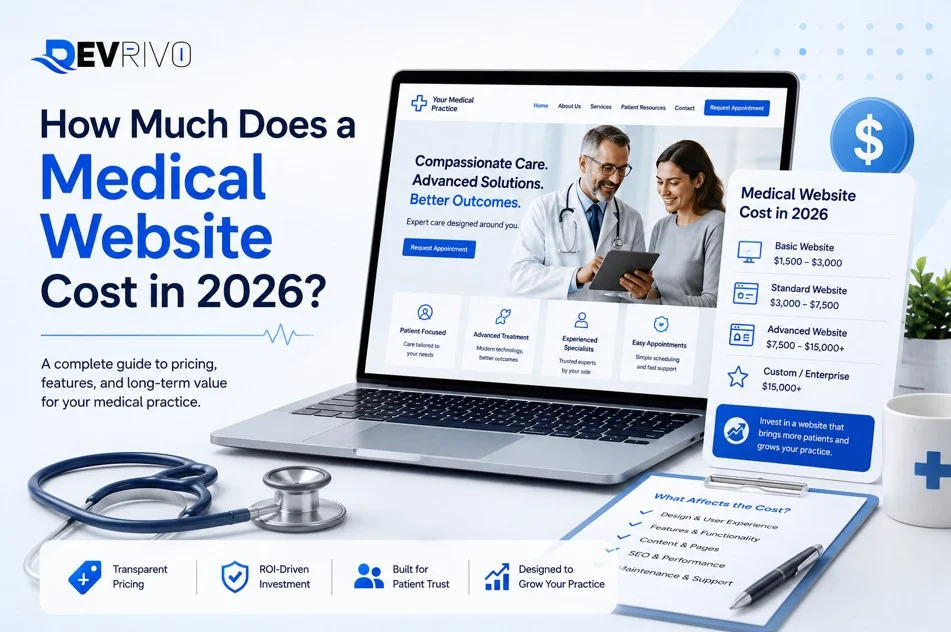
As a general planning guide, medical website projects can fall into several broad budget categories:
| Medical Website Type | Typical Scope | Planning Budget |
| Basic doctor website | Small informational website, core pages, contact/appointment CTA | 2,000–5,000+ |
| Professional medical practice website | Custom design, service pages, provider pages, SEO foundation | 5,000–10,000+ |
| Growing clinic website | More pages, multiple providers, stronger SEO, integrations | 10,000–25,000+ |
| Multi-location healthcare website | Location architecture, many services/providers, advanced SEO | 20,000–50,000+ |
| Complex healthcare platform | Custom functionality, advanced integrations, portals or workflows | 30,000–75,000+ |
These are planning ranges, not fixed market rates or standardized industry prices. A specific project may fall below or above them depending on requirements.
For comparison, publicly published 2026 healthcare pricing guides commonly place basic healthcare websites in the several-thousand-dollar range and more complex sites with appointment systems, patient-facing functionality, or integrations substantially higher.
A website quote should therefore be evaluated based on its deliverables, functionality, strategy, and ongoing support, not simply the final number.
What Determines Medical Website Pricing?
Several factors can significantly change the cost of a medical website.
1. Number of pages
A 10-page website requires less planning, content, design, development, and testing than a 100-page website.
However, page count alone does not determine price.
Ten highly customized pages can require more work than 30 pages built from a reusable template.
2. Design requirements
A template-based website generally requires less design work than a custom-designed website.
Custom design may involve:
- UX planning
- Custom page layouts
- Brand development
- Multiple design templates
- Mobile-specific layouts
- Conversion-focused CTAs
- Custom graphics
- Interactive elements
3. Functionality
Basic informational websites are relatively straightforward.
Additional functionality can increase development time and cost, including:
- Appointment booking
- Provider directories
- Location finders
- Search
- Patient forms
- Membership areas
- Custom calculators
- Scheduling integrations
- CRM integrations
- Analytics integrations
- Third-party APIs
4. Content
If the client supplies finished content, the project can move differently than one where the agency needs to research, write, edit, optimize, and publish dozens of medical pages.
5. SEO
A website built primarily for an online presence has different requirements from a website designed to compete for organic search visibility.
SEO work may include:
- Keyword research
- Search-intent mapping
- Information architecture
- Service-page planning
- Provider-page optimization
- Local SEO
- Internal linking
- Metadata
- Structured data
- Technical SEO
- Content optimization
6. Integrations
The more systems the website needs to communicate with, the more development and testing may be required.
7. Existing website
A brand-new website and a large SEO-sensitive redesign are not the same project.
A redesign may require:
- URL mapping
- Redirects
- Content migration
- SEO auditing
- Backlink considerations
- Analytics migration
- Indexing checks
That additional work can significantly affect the budget.
Medical Website Design Costs
Medical website design is more than choosing colors and putting a logo at the top of the page.
Professional design may include:
- User experience planning
- Navigation design
- Page hierarchy
- Mobile layouts
- Service-page templates
- Provider-page templates
- CTA placement
- Form design
- Typography
- Visual hierarchy
- Accessibility considerations
- Conversion paths
A lower-cost project may use an existing theme with limited customization.
A higher-cost project may involve custom UX and visual design for the specific practice.
The important distinction is what design work is actually included in the proposal.
Ask:
- Is the design custom?
- How many unique page templates are included?
- Are mobile layouts included?
- How many revision rounds are included?
- Who supplies images?
- Is UX planning included?
- Are conversion paths considered?
Two companies can quote completely different prices for “medical website design” because they are delivering different levels of work.
For practices that want the website to function as a long-term patient acquisition asset, the design should be considered together with SEO, content, usability, and conversion strategy.
Website Development Costs
Development turns the design into a functioning website.
Development costs can include:
- CMS setup
- Theme or framework configuration
- Responsive development
- Custom templates
- Forms
- Navigation
- Search
- Provider directories
- Location functionality
- Appointment integrations
- Analytics
- Performance optimization
- Security configuration
- Technical SEO
A website using a standard CMS and relatively simple functionality may require much less development than a custom healthcare platform.
For example:
Basic
Home + About + Services + Contact + simple forms
More advanced
Multiple providers + locations + service categories + appointment integration + advanced search + custom functionality
The second project is not simply “more pages.” It requires more technical planning, development, testing, and maintenance.
Medical Website Content Costs
Content is frequently overlooked when calculating the cost of a medical website.
A website may require:
- Homepage copy
- About-page copy
- Service pages
- Treatment pages
- Condition pages
- Provider biographies
- Location pages
- FAQs
- Patient resources
- Blog content
- Calls to action
Medical content also requires additional care because information should be accurate, clear, and appropriate for the intended audience.
If the client supplies high-quality content, the project may require less content production.
If the agency is responsible for researching, writing, editing, formatting, and optimizing dozens of pages, content becomes a substantial part of the project.
When reviewing a quote, ask:
Does the price include content writing, or do I need to provide everything?
That single question can explain a significant difference between two proposals.
SEO Costs
SEO can be included in the website project or purchased separately.
A basic website may include foundational SEO such as:
- SEO-friendly URLs
- Titles and descriptions
- Heading structure
- Image optimization
- Sitemap configuration
- Basic internal linking
- Indexability checks
A more comprehensive medical SEO implementation can include:
- Keyword research
- Competitor research
- Search-intent mapping
- Service-page strategy
- Provider-page strategy
- Location-page strategy
- Internal-link architecture
- Local SEO
- Structured data
- Technical SEO
- Content clusters
- Search Console setup
- Conversion tracking
This distinction matters.
A proposal that says “SEO included” does not necessarily mean ongoing medical SEO is included.
Ask whether SEO means:
SEO setup once
or
ongoing SEO strategy and optimization.
They are different services.
For practices that want to acquire patients through organic search, it is usually better to plan SEO during website architecture and development rather than attempting to retrofit it after launch.
Provider and Location Pages
Provider and location pages can add significant scope to a healthcare website.
A multi-provider practice may need individual pages for:
- Physicians
- Surgeons
- Dentists
- Therapists
- Nurse practitioners
- Other healthcare professionals
A multi-location organization may also need individual pages for:
- Each clinic
- Each city
- Each service area
- Location-specific services
These pages are useful for patients and can also support the site’s organic search architecture when they represent genuine, useful information.
For example, a clinic with:
- 15 providers
- 5 locations
- 20 core services
may require substantially more planning than a solo physician website.
However, creating pages simply to increase the page count is not a good pricing strategy. Each page should have a clear purpose and useful content.
Appointment and Third-Party Integrations
Healthcare websites often need to connect with external systems.
Examples include:
- Appointment scheduling
- Online booking
- CRM systems
- Marketing platforms
- Analytics
- Maps
- Review platforms
- Telehealth systems
- Patient-facing tools
A simple external booking link is different from a custom integration.
The more complicated the integration, the more development and testing may be required.
There may also be separate costs from the third-party software provider.
That means your website budget should distinguish between:
Website development cost
and
Third-party platform or subscription cost.
For systems that handle sensitive patient information, security, privacy, contractual responsibilities, and applicable healthcare requirements should be evaluated separately. A website agency should not automatically represent a particular integration as making the entire website “HIPAA compliant.”
Custom vs. Template Medical Websites
One of the biggest pricing differences comes from how the website is designed and built.
| Approach | Lower Cost | Higher Cost |
| Starting point | Existing theme/template | Custom design/system |
| Design | Limited customization | Tailored UX and visual design |
| Page templates | Fewer variations | Multiple custom templates |
| Development | Mostly standard | More custom functionality |
| Flexibility | More limited | Greater flexibility |
| Launch | Often faster | Usually more planning |
| Long-term changes | Depends on platform/theme | Depends on architecture |
| Best suited for | Simple websites | Growth-focused or complex practices |
Neither approach is automatically right for every practice.
A small practice with straightforward requirements may not need a heavily customized platform.
A growing healthcare organization with multiple providers, locations, services, integrations, and SEO requirements may need a more structured solution.
The goal is to match the technology and design investment to the actual business requirements.
Medical Website Redesign Costs
A medical website redesign can cost less than a new website or considerably more depending on what needs to change.
A simple visual refresh might involve:
- New branding
- Updated layouts
- Mobile improvements
- Content updates
- Navigation improvements
A full redesign may involve:
- New information architecture
- New page templates
- New content
- SEO restructuring
- URL changes
- Redirect mapping
- CMS migration
- Performance improvements
- Accessibility improvements
- New integrations
The key question is:
Are you redesigning the appearance, or rebuilding the website’s underlying structure?
A full redesign should also account for existing SEO value.
Important pages should not simply disappear because a new design is being launched. Existing URLs, rankings, backlinks, and useful content should be reviewed before changes are made.
If the website already generates organic traffic, SEO migration planning should be part of the redesign scope.
Ongoing Website Maintenance Costs
The initial website build is not the only cost to consider.
After launch, ongoing medical website maintenance expenses may include:
- Hosting
- Domain renewal
- Premium software or plugins
- Security monitoring
- CMS updates
- Backups
- Technical support
- Content updates
- Bug fixes
- Performance monitoring
- SEO maintenance
Some practices handle routine updates internally.
Others prefer an ongoing website maintenance plan.
Maintenance is particularly important for websites that rely on multiple plugins, integrations, forms, third-party services, or frequently changing content.
A low-cost website that becomes difficult to maintain can become more expensive over time than a well-structured website with predictable support.
What Should Be Included in a Medical Website Quote?
A professional proposal should make the scope easy to understand.
At minimum, look for:
Strategy
- Project goals
- Target audience
- Website scope
- Sitemap
- Technical requirements
Design
- UX planning
- Visual design
- Responsive design
- Page templates
- Revision rounds
Development
- CMS/platform
- Theme or custom development
- Forms
- Integrations
- Functionality
- Testing
Content
- Number of pages
- Content writing
- Content editing
- Provider biographies
- Image sourcing
SEO
- Keyword research
- Metadata
- Technical SEO
- Internal linking
- Structured data
- Sitemap/indexing setup
Launch
- Hosting setup
- Domain/DNS assistance
- Migration
- Redirects
- Analytics
- Search Console
- Final QA
Post-launch
- Warranty/support period
- Maintenance
- Updates
- Security
- Future changes
If a proposal simply says “10-page medical website – $X”, you do not yet know enough to compare it with another proposal.
How to Compare Medical Website Proposals
Do not compare proposals by price alone.
Instead, compare them line by line.
| Proposal Factor | Questions to Ask |
| Pages | How many pages and templates are included? |
| Design | Custom or template-based? |
| Content | Who writes and uploads the content? |
| SEO | What exactly does “SEO included” mean? |
| Development | What functionality is included? |
| Integrations | Which systems are connected? |
| Migration | Are redirects and URL mapping included? |
| Hosting | Is hosting included or separate? |
| Ownership | Who owns the website and content? |
| Support | What happens after launch? |
| Maintenance | Are updates included? |
| Revisions | How many rounds are included? |
| Timeline | What is the expected delivery schedule? |
| Extra work | How are scope changes priced? |
A $3,000 proposal and a $10,000 proposal may not actually be competing products.
Budget and schedule are closely connected, so understanding how long it takes to build a medical website can help you evaluate whether a proposed project scope and price are realistic.
One may provide a template, client-supplied content, basic setup, and limited support.
The other may include custom UX, content, SEO architecture, development, migration, QA, analytics, and ongoing support.
The right comparison is therefore:
What am I getting for the price?
Medical Website Cost Checklist
Before approving a proposal, use this checklist.
Project scope
- Number of pages defined
- Page types defined
- Sitemap included
- Functionality documented
- Integrations documented
- Timeline provided
Design
- Custom vs. template clearly stated
- Mobile design included
- Revision policy included
- Page templates identified
Content
- Content responsibility defined
- Provider pages included
- Service pages included
- Location pages included if required
- Images defined
SEO
- Keyword research defined
- Metadata included
- Internal linking included
- Technical SEO included
- Structured data addressed
- Sitemap/indexing setup included
Technical
- Hosting defined
- Domain responsibility defined
- Analytics included
- Search Console included
- Backups/security addressed
- Integrations tested
Migration
- Existing URLs reviewed
- Redirects included
- Content migration included
- SEO migration included
- Post-launch indexing checks included
Post-launch
- Support period defined
- Maintenance options explained
- Update responsibilities defined
- Future work pricing explained
What Is a Reasonable Budget for Your Medical Website?
There is no universal “reasonable” price without knowing the project scope.
Instead, start with the business requirements.
A solo doctor with a small number of services may need a relatively simple website.
A growing clinic may need:
- Multiple providers
- More service pages
- Local SEO
- Appointment functionality
- Location pages
- Conversion-focused design
- Ongoing content
A larger healthcare organization may need:
- Multiple locations
- Hundreds of pages
- Advanced search
- Custom integrations
- Complex content architecture
- Migration
- Advanced technical SEO
- Ongoing development
The budget should grow because the scope and business requirements grow, not simply because the website is for a medical organization.
Frequently Asked Questions
How much does a medical website cost in 2026?
A medical website can cost from a few thousand dollars for a simple doctor website to tens of thousands of dollars or more for larger healthcare projects. The final price depends on design, development, content, SEO, integrations, number of providers and locations, and other requirements.
How much does medical website design cost?
Medical website design costs vary according to whether the site uses a template or custom UX and visual design. The number of page templates, revisions, branding requirements, mobile design, and conversion requirements can all affect the price.
How much does a doctor website cost?
A simple doctor website generally costs less than a multi-provider medical practice website because it usually requires fewer pages, templates, integrations, and content. A custom doctor website with extensive SEO and functionality can cost substantially more.
How much does a clinic website cost?
Clinic website costs depend on the number of providers, services, locations, content requirements, integrations, and SEO scope. A multi-location clinic can require significantly more work than a small single-location practice.
Does medical SEO increase website cost?
It can. Keyword research, content planning, technical SEO, internal linking, structured data, local SEO, and migration planning all require additional work. However, integrating SEO into the website project can be more efficient than rebuilding the site’s architecture later.
Is a template medical website cheaper?
Usually, a template-based website requires less initial design work. However, the total cost should still be evaluated based on customization, functionality, content, SEO, support, and long-term maintenance.
Is hosting included in medical website pricing?
Not always. Some proposals include hosting for a specific period, while others charge hosting separately. Always check whether hosting, domain renewal, premium plugins, licenses, backups, and maintenance are included.
How much does a medical website redesign cost?
A redesign can range from a relatively small visual update to a complete rebuild. If the project involves new architecture, content, SEO migration, redirects, integrations, and custom development, the cost can be substantially higher than a simple visual refresh.
Should SEO be included in the website development cost?
At minimum, the website should be built with SEO fundamentals in mind. If the practice expects the website to generate meaningful organic traffic, a more comprehensive SEO strategy may need to be scoped separately or included as a defined part of the project.
Final Takeaway
Medical website cost is determined by scope not by the word “medical” alone.
The biggest cost factors are usually:
- Design complexity
- Number and type of pages
- Content production
- SEO requirements
- Provider and location architecture
- Custom functionality
- Appointment and third-party integrations
- Migration requirements
- Testing
- Ongoing maintenance
A cheap quote is not automatically a bad quote, and an expensive quote is not automatically a better one.
The important question is whether the proposal gives your practice the right combination of strategy, design, development, SEO, functionality, ownership, and support for what you actually need.
Before choosing a medical website provider, ask for a detailed scope of work and compare the deliverables not just the final price.
If you are planning a new medical website or replacing an outdated one, start by defining your required pages, functionality, SEO goals, integrations, and ongoing support needs. Those requirements will give you a much more realistic project budget than choosing a price based on page count alone.